


The short answer
Most range hood problems, including weak suction, a noisy or dead blower, unresponsive controls, and failed lights, can be repaired without replacing the hood. Viking Repair Experts diagnoses Viking, Wolf, and Thermador hoods in San Jose and nearby cities and explains the fault and your options before any work begins.
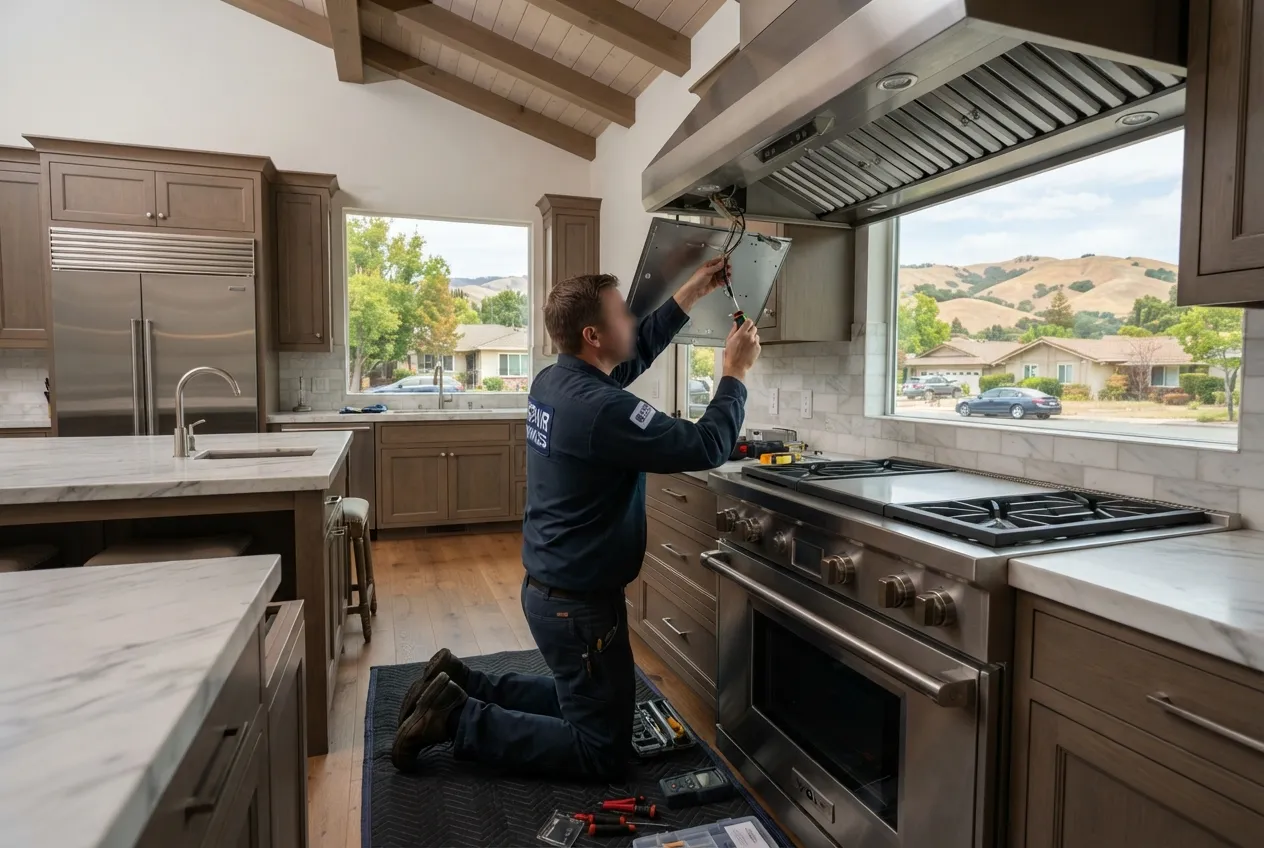
A range hood is easy to ignore until it stops pulling smoke, starts rattling, or won't turn off. On a professional-style kitchen, the hood does real work: it clears heat, grease, and cooking fumes from high-output burners and griddles. Viking Repair Experts repairs built-in and professional-style range hoods in San Jose and surrounding South Bay cities. We work mainly on Viking ventilation, along with Wolf and Thermador hoods, and we often service hoods in kitchens built around Sub-Zero refrigeration. We are an independent repair company with no brand affiliation. This page covers common problems, what a technician checks, and how a visit works.
Issues we fix
Hood problems usually show up in one of three ways. The fan doesn't move enough air, it makes noise it didn't used to make, or the controls and lights stop behaving. Here are the symptoms homeowners call us about most:
- Fan won't turn on at any speed
- Weak suction, so smoke and cooking odors linger in the kitchen
- Fan stuck on one speed or won't shut off
- Rattling, humming, grinding, or a vibrating hood body
- Blower runs but little air moves, which often points to a stuck damper or blocked duct
- Lights out or flickering, including heat lamps on some professional models
- Touch controls or switches that don't respond
- Fan turning on by itself, sometimes caused by a heat sensor or control fault
- Grease dripping from the filters or hood edges
- Remote or in-line blower not running even though the hood has power
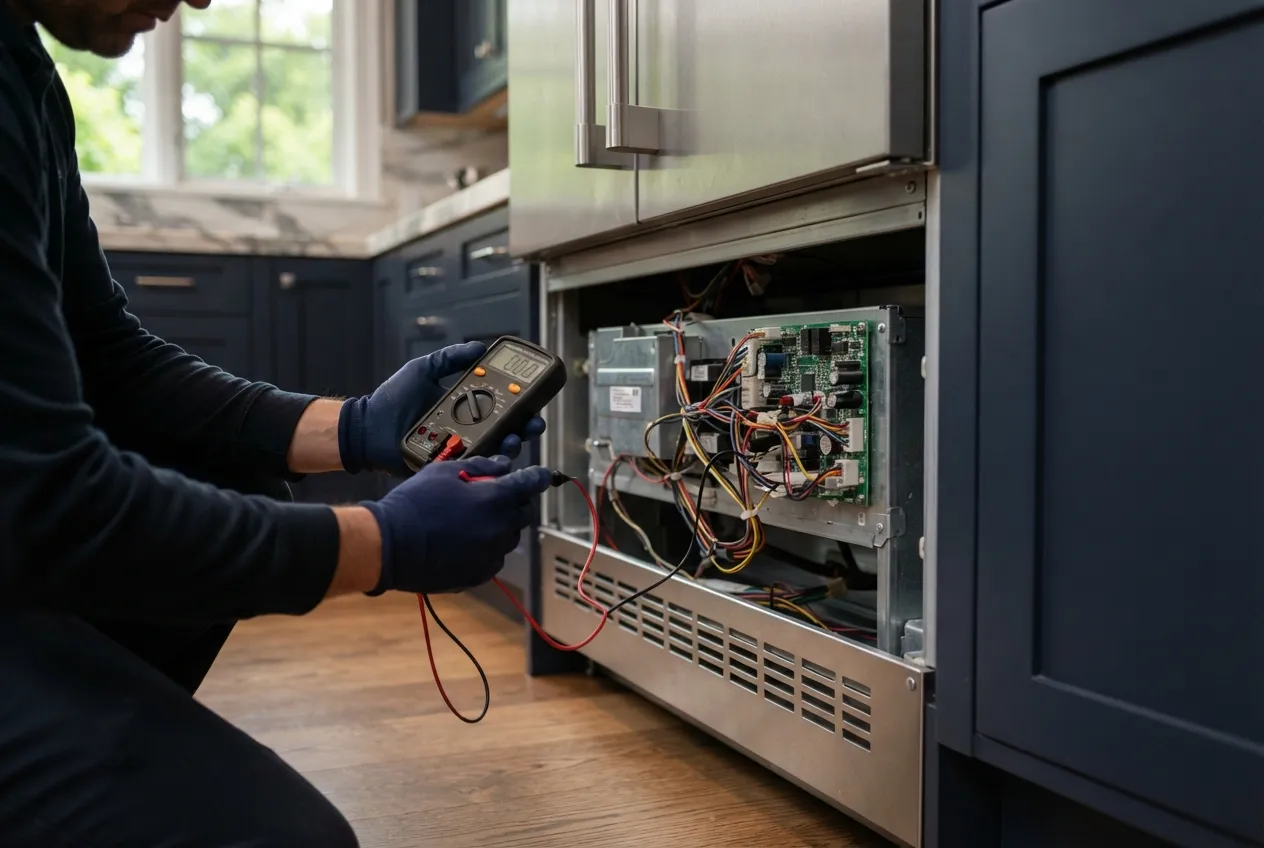
What our technician checks on a built-in or professional hood
We start with the basics: power at the hood, the circuit, and any wall control or remote. Then we work through the parts that fail most often. We check the switches or touch panel and the control board. We look at the blower motor and its capacitor, and we inspect the blower wheel for grease buildup or imbalance. We also check the light sockets and transformers.
Airflow problems often have nothing to do with the motor. We pull the baffle or mesh filters, look for grease restricting the intake, and check the backdraft damper and as much of the duct run as we can reach. If your home has a makeup air system tied to the hood, we confirm the interlock is signaling correctly. For hoods with a remote or in-line blower mounted in the attic or on the roof, we trace the wiring between the hood and the blower. That connection is a common failure point.
How Viking, Wolf, Thermador, and Sub-Zero kitchens differ
Viking professional hoods are often paired with high-BTU ranges and rangetops. Their blowers work hard, so we see worn motors, failed switches, and greasy blower wheels that throw the fan off balance. Some models have heat lamps, and their sockets and bulbs wear out over time.
Wolf offers wall, island, and insert hoods, plus downdraft ventilation and remote blower setups. On these units, electronic controls and the wiring to a remote blower get extra attention. Downdraft units can also have problems with the lift mechanism.
Thermador hoods are often custom inserts built into decorative enclosures, and downdraft systems are common. Electronic control faults and access inside custom surrounds come up often.
Sub-Zero makes refrigeration, not hoods. Many of the kitchens we visit pair a Sub-Zero refrigerator with a Wolf or Viking cooking and ventilation setup, so we can look at those appliances on the same visit if needed.
Tell us what your appliance is doing.
Repair or replace a high-end range hood?
In most cases, repair makes sense. A premium hood's shell, baffles, and ductwork rarely wear out. Motors, capacitors, switches, boards, and lights do, and those parts can be replaced. Replacing the whole hood can also mean reworking the custom cabinetry or enclosure, adjusting the ductwork, and matching the blower size to your range. Repair avoids all of that.
Replacement is worth considering when parts are no longer available for an older model, when the housing itself is damaged, or when you're remodeling and changing your cooking setup anyway. If a hood never cleared smoke well, even when new, it may be undersized for your range or poorly ducted. Repair won't fix that, and we'll tell you so.
What affects the cost of a range hood repair
We give you a clear explanation once we've diagnosed the hood. Several factors shape the cost:
- The fault itself: a switch or light socket is a simpler job than a blower motor or control board
- Parts: brand-specific parts vary in cost and availability, and some older models need parts ordered
- Access: inserts built into custom wood or plaster surrounds, island hoods, and remote blowers in attics or on roofs take more time to reach
- Grease and debris: a heavily coated blower or duct may need cleaning before it can be properly tested or repaired
- Number of trips: if a part has to be ordered, the repair is finished on a return visit
How a visit works
When you contact us, tell us the brand, the model number if you can find it (usually on a label behind the filters), and what the hood is doing. That helps the technician come prepared.
At the visit, the technician confirms the symptom and runs through the checks above. Then they explain what failed and what the repair involves. You decide whether to go ahead. If the part is on hand, many repairs are finished the same day. If it needs to be ordered, we schedule a return visit to install it and test the hood at every speed and light setting.
We serve San Jose and nearby South Bay cities. Hoods tend to get heavy use year-round in the Santa Clara Valley's mild climate, and a quick check before a busy cooking season can catch a struggling motor early.