




The short answer
Most microwave drawer problems come from the drawer drive, door switches, controls, or the high-voltage heating parts, and many of these can be repaired without replacing the unit. A technician tests each system, explains what failed, and gives you repair and replacement options before any work starts.
A microwave drawer sits low in an island or base cabinet, opens at the touch of a button, and often gets used several times a day. When it stops heating, won't slide out, or the touch panel goes dark, you notice right away. Viking Repair Experts repairs built-in microwave drawers for homeowners in San Jose and nearby cities. We work on Viking, Wolf and Thermador models, including drawers installed alongside Sub-Zero refrigeration in custom kitchens. We are an independent repair company and are not affiliated with or endorsed by any appliance brand. Below is what typically goes wrong, what we check, and how to decide whether a repair makes sense for your unit.
Issues we fix
Microwave drawers combine two systems in one appliance: a motorized drawer that opens and closes, and a microwave that heats food. A problem in either one can stop the whole unit, so the symptom you see isn't always where the fault is. These are the problems owners call us about most often:
- Drawer won't open or close, stops partway, or reverses direction
- Drawer opens and the unit runs, but food doesn't heat or heats weakly
- Touch panel unresponsive, some keys dead, or the display is blank
- Error codes on the display or repeated beeping
- Sparking, arcing, or a burning smell inside the cavity
- Uneven heating, with hot edges and a cold center
- Cooling fan runs constantly or doesn't run at all
- Loud humming, buzzing, or grinding during cooking or drawer travel
- Interior light out, or the unit trips a breaker or GFCI
- Drawer sits crooked, rubs the cabinet, or doesn't close flush
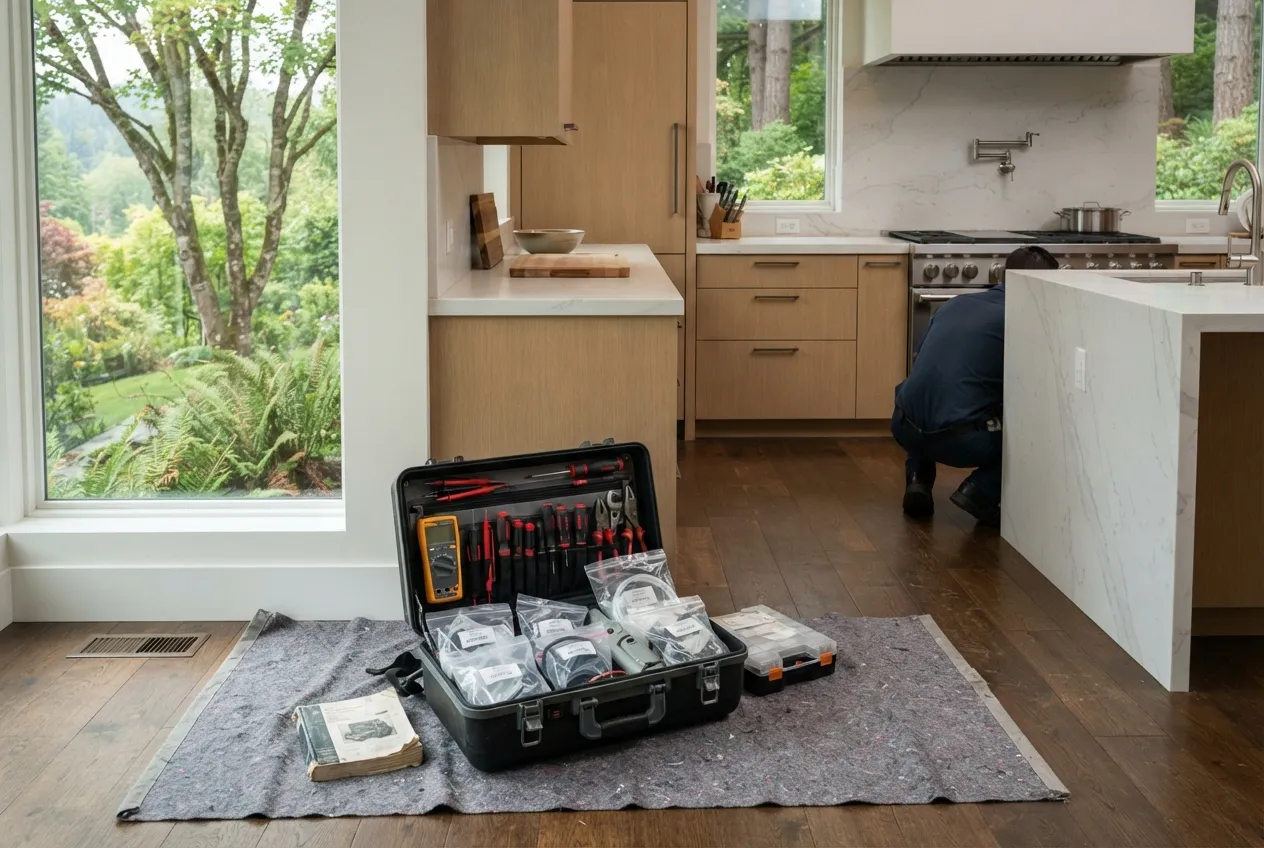
What our technician checks
Please don't remove panels yourself. A microwave contains a high-voltage capacitor that can hold a dangerous charge even after the unit is unplugged or the breaker is off. Our technician discharges it safely before testing internal parts.
On the drawer side, we check the drive motor, gear rack, rails and rollers, and the position sensors that tell the control where the drawer is. A worn gear or a misread sensor often explains a drawer that stops halfway or won't respond.
For heating problems, we test the door interlock switches, magnetron, high-voltage transformer, capacitor and diode, along with thermal cutouts that shut the unit down when it overheats. We also check the control board and touch panel, the cooling fan and airflow paths, and the incoming power at the outlet or dedicated circuit.
Finally, we look at the installation. A cabinet cutout that is out of level, too tight, or blocking ventilation can cause drawer binding and heat-related shutdowns that come back after a part is replaced.
How Viking, Sub-Zero, Wolf and Thermador drawers differ
Across brands, the parts that fail most are usually the ones that move or handle heat and steam: the drawer mechanism, door switches, touch controls, and cooling components. The model and production generation usually matter more than the name on the front.
Viking microwave drawers often show up in kitchens built around Viking ranges. On older units, drawer drive wear and control panel problems are common, and parts availability is worth confirming early.
Sub-Zero makes refrigeration rather than microwave drawers, but many kitchens with Sub-Zero refrigerators pair them with a Wolf microwave drawer, and we service both. Wolf drawers are frequently installed flush or in islands, so access and trim removal take careful handling.
Thermador drawers are also common in integrated kitchens. Touch control and drawer operation problems are typical service calls. Because designs vary by model year, we always work from the model and serial number on your specific unit.
Tell us what your appliance is doing.
Repair or replace a high-end microwave drawer
Replacement is not as simple as it sounds with a built-in unit. Cutout dimensions, trim kits, and electrical locations differ between brands and generations, so a new drawer may not fit your existing opening without cabinet changes. That is a strong reason to repair when it's practical.
Repair usually makes sense when the fault is a drawer gear, switch, sensor, fuse, fan, or a single heating component, and the rest of the unit is in good shape. Replacement deserves a closer look when the unit is older, parts are discontinued, or several major parts are failing at once, such as the magnetron and the control board. We'll tell you plainly which situation you're in.
What affects the cost of repair
We can't quote a price before diagnosis, because the cost depends on what actually failed. These are the main factors:
- The fault itself: a door switch or drawer gear is a smaller job than a magnetron or control board
- Part type and availability, including lead times for older or less common models
- Access: removing a drawer from custom cabinetry, an island, or a panel-ready front takes more time
- Whether the part is on hand or a second visit is needed after ordering it
- Related damage, such as a scorched cavity from arcing or a worn rail affecting alignment
How a repair visit works
When you book, tell us the brand, what you're seeing, and any error code. If you can, note the model and serial number. On most drawers the label is visible on the frame or drawer side when the drawer is open.
Our technician arrives, discharges the unit safely, and tests the drawer and heating systems to find the cause. Before any work starts, we explain what failed and lay out your options. If the part is on hand, we can often repair it the same visit. If not, we order it and schedule a return.
After the repair, we run the drawer through full open and close cycles and test heating to confirm it works. To prepare, clear the area in front of the drawer and know where your electrical panel is.